Key takeaways
- A Fully Automatic Liquid Filling Machine minimizes product waste through precise control over filling volumes and bottle positioning.
- Implementing servo-controlled dosing in a Fully Automatic Liquid Filling Machine enhances filling accuracy, reducing overfilling and product giveaway.
- Drip-free nozzles in these machines prevent liquid residue, contributing to a cleaner production line and less waste.
- Choosing the right Fully Automatic Liquid Filling Machine Manufacturer in India ensures tailored solutions for specific production needs and liquid types.
- No-bottle no-fill control systems in automated machines reduce spillage, providing a more efficient filling process.
Liquido is a leading Fully Automatic Liquid Filling Machine Manufacturer providing automated liquid filling solutions for high-volume packaging applications.
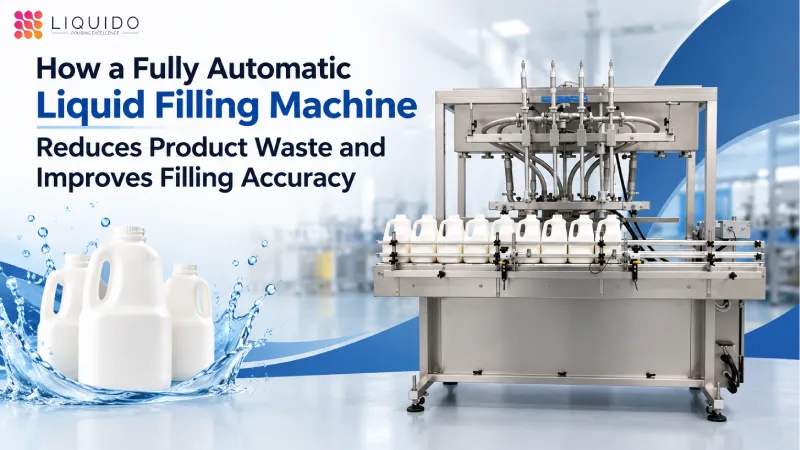
Product giveaway, dripping, incorrect fill volumes and spills can increase material loss during repetitive bottle filling. A Fully Automatic Liquid Filling Machine brings controlled dosing, automated bottle positioning and repeatable filling into one continuous process. For manufacturers handling valuable liquids at scale, improving filling consistency can reduce avoidable waste while helping every production batch maintain a more uniform output.
Where Product Waste Occurs During Liquid Filling
Liquid can be wasted at several points in a filling operation. Overfilling gives away more product than intended, while dripping after the filling cycle can leave liquid on bottles, conveyors or machine surfaces.
Incorrect bottle positioning can also cause spills if filling begins before a container is correctly placed beneath the nozzle. These problems become more significant during continuous production because even small inconsistencies can repeat across many containers.
A well-configured automated filling system targets common causes of waste such as:
- Overfilling beyond the preset volume
- Dripping between filling cycles
- Filling when a bottle is missing or misplaced
- Excess foaming during product dispensing
- Inconsistent manual volume adjustments
- Spillage during repetitive bottle handling
Controlling the filling cycle is therefore central to reducing unnecessary product loss.
How Automated Dosing Improves Filling Accuracy
A Fully Automatic Liquid Filling Machine doses liquid according to predefined machine settings instead of depending on repeated manual measurement. Bottles enter through the conveyor, position beneath the filling heads and receive a controlled quantity before moving to the next packaging stage.
The Liquido machine is available with servo-controlled filling technology and has a stated filling range of 100 ml to 5 litres. Its technical specification lists filling accuracy of ±0.5%, depending on the liquid type.
As a Fully Automatic Liquid Filling Machine Manufacturer in India, we configure the filling system around factors such as product characteristics, required fill volume, bottle format and production requirement.
Servo-Controlled Filling Reduces Product Giveaway
Product giveaway occurs when containers consistently receive more liquid than the required filling quantity. While a small excess may appear insignificant on one bottle, repeated overfilling across continuous production can consume additional product.
Servo-controlled dosing allows the filling volume to be set and repeated through automated machine control. Rather than relying on operator judgment for every container, the machine follows the selected filling parameters throughout the run.
The basic process follows a repeatable sequence:
- Empty bottles enter through the conveyor.
- Bottles are positioned beneath the filling heads.
- The selected volume is dispensed through the filling nozzles.
- The filling cycle stops at the configured point.
- Filled bottles discharge toward the next packaging operation.
This controlled sequence helps reduce unnecessary variation between containers.
Drip-Free Nozzles Help Keep Product Inside the Bottle
Dripping after filling is another source of avoidable product loss. It can also leave residue around bottle necks, threads and conveyor surfaces, creating additional cleaning requirements before capping or labelling.
Our Fully Automatic Liquid Filling Machine incorporates drip-free nozzle technology designed to control liquid discharge at the end of the filling cycle. Depending on the application, filling arrangements can also be selected to suit product viscosity and filling behaviour.
Liquido offers fully automatic filling systems with volumetric piston, time-pressure or servo, peristaltic and flow-meter filling principles, depending on the application requirements.
Selecting the correct filling principle is important because a free-flowing beverage does not behave in the same way as oil, cosmetic liquid or lubricant.
No-Bottle No-Fill Control Prevents Unnecessary Spillage
An empty space on the conveyor should not trigger a normal filling cycle. No-bottle no-fill control detects whether the required container is correctly present before liquid is dispensed.
This feature can reduce product being discharged onto the conveyor when bottles are absent or incorrectly positioned.
For production teams evaluating a Fully Automatic Liquid Filling Machine Manufacturer, this type of machine control is worth considering alongside filling speed and head count. Waste reduction depends not only on dosing accuracy but also on how the machine responds when normal bottle flow is interrupted.
Accuracy and Waste Reduction Work Together
Better accuracy and lower product waste are closely connected. A filling system that repeatedly controls its dispensing volume reduces the need to compensate for inconsistent fills by intentionally overfilling containers.
| Filling Factor | Poor Control Can Cause | Automated Control Helps With |
|---|---|---|
| Fill volume | Overfill or underfill | Repeatable preset dosing |
| Nozzle shut-off | Drips and residue | Cleaner filling cycle |
| Bottle detection | Conveyor spills | No-bottle no-fill response |
| Product handling | Foaming or overflow | Suitable nozzle configuration |
| Changeover | Setting variation | Repeatable machine settings |
The goal is not simply to fill faster. Accurate filling means controlling how much product enters each container while limiting avoidable losses around the filling process.
Matching Filling Heads to Production Requirements
Liquido offers 4, 6, 8, 10 and 12-head configurations, with custom options available. The appropriate number of filling heads depends on factors including desired output, fill quantity, liquid characteristics and the surrounding packaging line.
Multiple filling heads allow several bottles to be processed within the automated cycle. However, increasing the head count should be based on actual line requirements rather than treating more heads as automatically better.
As a Fully Automatic Liquid Filling Machine Manufacturer in India, we assess the complete application when configuring a machine so that dosing, bottle movement and line integration work together.
What B2B Buyers Should Check Before Selecting a Machine
Filling accuracy depends on more than a specification printed on a machine sheet. Product behaviour and production conditions can influence the most suitable filling technology.
Before choosing a Fully Automatic Liquid Filling Machine, buyers should verify:
- Required fill volume and container capacity
- Liquid viscosity and flow characteristics
- Bottle shape, neck size and dimensions
- Required number of filling heads
- Target production output
- Preferred contact-part material
- Compatibility with capping, labelling and conveyor equipment
A Fully Automatic Liquid Filling Machine Manufacturer should understand these operating conditions before recommending a configuration.
Why Choose Us
At Liquido, we develop automatic liquid filling systems around practical production requirements such as filling accuracy, waste control, hygienic product contact and packaging-line integration. Our fully automatic model is available with an SS 304 structure, SS 316 contact parts, servo-controlled volume settings and multiple filling-head configurations. As a Fully Automatic Liquid Filling Machine Manufacturer in India, our team works with manufacturers across edible oils, beverages, chemicals, pharmaceuticals, cosmetics and lubricants to identify suitable filling configurations for their applications.
Conclusion
Reducing liquid waste requires control over dosing, nozzle operation, bottle detection and repeated filling cycles. A properly configured Fully Automatic Liquid Filling Machine can limit overfilling, dripping and unnecessary spills while delivering more consistent fill quantities throughout continuous production. Features such as servo-controlled dosing, drip-free nozzles and automated bottle handling give manufacturers greater control over the filling process. Working with an experienced Fully Automatic Liquid Filling Machine Manufacturer in India also helps align the machine with the liquid, container, fill volume and production-line requirements rather than selecting equipment on speed alone.
Looking for an automated filling solution that can improve filling consistency while reducing unnecessary product loss? Contact Liquido and discuss your liquid type, bottle size, required fill volume and production target with our team.
Call: +91 98000 05293
Email: info@liquidofill.com
Speak with our team today to select a filling configuration suited to your production and packaging requirements.
Need help choosing the right machine?
Talk to our engineers for a configuration matched to your product and line.
Frequently asked questions
A Fully Automatic Liquid Filling Machine minimizes product waste by implementing controlled dosing, automated bottle positioning, and repeatable filling processes. This reduces issues like overfilling, dripping, and incorrect bottle placement, ensuring that each fill is accurate and consistent.
When choosing a Fully Automatic Liquid Filling Machine Manufacturer in India, consider key features such as servo-controlled filling technology, drip-free nozzle systems, and no-bottle no-fill controls. These features significantly enhance filling accuracy and minimize unnecessary spills.
Automated dosing provides precise liquid measurements based on predefined machine settings, which eliminates the variability inherent in manual filling. This ensures that every bottle receives a consistent amount of liquid, improving overall production efficiency.
Common causes of product waste during liquid filling include overfilling, dripping after the filling cycle, and incorrect bottle positioning. Each of these problems can lead to significant material loss, especially in high-volume production settings.
Selecting the right filling principle is crucial because different liquids, such as beverages, oils, and cosmetics, have unique viscosities and flow characteristics. A proper filling method tailored to the specific product ensures accurate dosing and reduces the risk of spills and waste.